
[ad_1]
On Saturday, Ramesh Chander sowed bajra (pearl millet) on eight acres using a 50-horsepower tractor-mounted seed drill machine.
He plans to sow seeds of the ‘Proagro 9001’ hybrid on another six acres next month, after harvesting the standing moong (green gram) crop on that field. “I will grow bajra on 14 acres this year, from nine in 2025 and two acres in 2024,” says the 40-year-old with a total 34-acre holding in Kusambi village of Haryana’s Sirsa district.
The higher bajra acreage is at the expense of narma (cotton). Chander had cultivated the natural fibre crop on 23 acres in 2024, which he reduced to 12 last year: “This time, I may do just one acre”.
Chander gives three reasons for virtually deserting cotton.
The first is the threat from gulabi sundi or pink bollworm. Till 4-5 years ago, kapas (raw un-ginned cotton) yields were 10-12 quintals per acre. In 2024, Chander’s average fell to 3.5 quintals. Last year, he harvested only 31 quintals from his 12 acres due to the insect pest, whose larvae bore into the bolls (fruits) of cotton plants and feed on the developing seeds and fibre inside, causing yield loss and lint discolouration.
Gulabi sundi has emerged as a major threat in the narma belt of Northwest India, covering Bhiwani, Hisar, Fatehabad and Sirsa in Haryana, Mansa, Bathinda, Muktsar and Fazilka in Punjab, and Hanumangarh and Sri Ganganagar in Rajasthan.
The second reason is labour shortage for picking cotton, with the cost ranging from Rs 12 to Rs 25 per kg. Even if narma is fetching over Rs 8,500 per quintal in the Sirsa wholesale market now, as against Rs 7,500 a year ago, yield uncertainty and rising picking costs have made cotton unattractive for farmers.
Input crunch
The third factor has to do with chemical inputs – fertilisers and pesticides.
Story continues below this ad
For cotton, Chander applies two 50-kg bags of single super phosphate (SSP), half-a-bag of muriate of potash (MOP) and 10 kg of sulphur bentonite per acre during sowing, followed by one bag of di-ammonium phosphate (DAP) and two 45-kg urea bags after 1.5 months.
He also sprays insecticides such as ‘Coragen’ (Chlorantraniliprole), ‘Proclaim’ (Emamectin Benzoate), ‘Delegate’ (Spinetoram) and Cypermethrin for controlling American bollworm, spotted bollworm, tobacco caterpillars, thrips, jassids and aphids.
“The total sprays are anywhere from five to 10 over the crop’s life cycle of 180-185 days. And these chemicals don’t work against gulabi sundi,” points out Chander.
In bajra, per-acre fertiliser use is just two bags of SSP and two urea bags, along with two 80-gram sprays of ‘Proclaim’ to control top borer. “I get 18-20 quintals/acre grain yield from Proagro 9001, which matures in 90-95 days. And only 1-2 irrigations are necessary, compared to 5-7 in cotton,” he adds.
Story continues below this ad
Satyender Singh, Chief Executive Officer (Seeds) at Crystal Crop Protection Ltd, sees a clear trend of Northwest India farmers moving away from cotton.
“Yield losses from pink bollworm, long growing period, and rising input and labour costs are definitely discouraging them,” notes Singh, whose Delhi-based company markets the Proagro 9001, 9190 and 9180 bajra hybrids. Proagro 9001 alone was planted in roughly 1.6 million acres area across Uttar Pradesh, Madhya Pradesh (MP), Rajasthan and Haryana in the 2025 kharif (monsoon) season.
Planting flexibility
The bajra Chander would sow in June 15-20 is harvestable three months later, giving him ample time to plant a 130-140 days rabi (winter-spring) mustard crop by mid-October. After that is harvested, he can sow a 60-65 days zaid (summer) moong crop from mid-March to mid-April.
“Bajra allows farmers to take an extra crop. With cotton (sowing time from mid-April to mid-May), they can only go for wheat in November and there is no scope to plant summer moong after that,” adds Singh.
Story continues below this ad
What Chander wants from the government is assured minimum support price (MSP)-based procurement: “Last year, I sold my bajra at Rs 2,100 per quintal. Even after adding the Rs 300 bonus under the Haryana government’s Bhavantar Bharpai Yojana, the effective rate of Rs 2,400 was below the official MSP of Rs 2,775/quintal. This time, the MSP has been raised to Rs 2,900/quintal, but they should guarantee it through actual procurement or payment of price difference over the market rate”.
West Asia woes
A major uncertainty that Indian farmers are facing ahead of kharif plantings, which will take off with the monsoon rains from June, is fertilisers.
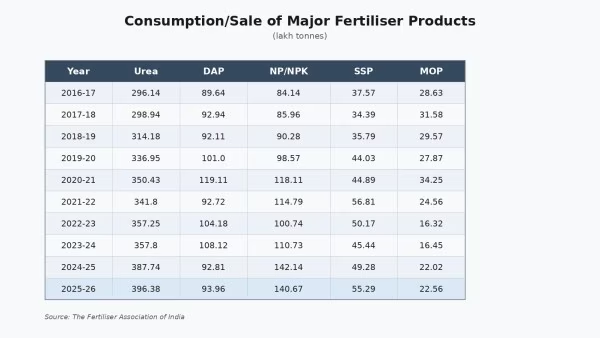
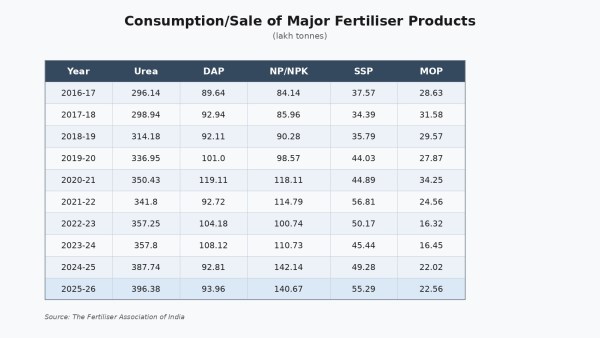
Between 2016-17 and 2025-26 (April-March), domestic sale of urea has gone up from below 300 lakh to nearly 400 lakh tonnes. Consumption of DAP, SSP and complex fertilisers containing nitrogen, phosphorus, potassium and sulphur in different proportions have also significantly increased over this period (see table).
This year, fertiliser availability is a challenge, because of the unresolved United States-Israel versus Iran conflict and closure of the vital Strait of Hormuz waterway since February 28.
Story continues below this ad
While the requirement of fertilisers isn’t much in bajra, moong and other pulses, that’s not so with paddy or maize. Chander planted the Pusa Basmati 1401 paddy variety on nine acres in 2024 and 13 acres in 2025. He seeks to take it to 19 acres this year, but the crop needs three bags of urea, one bag of DAP, half-a-bag of MOP and 4 kg of zinc sulphate.
The challenge is still more in maize.
Rakesh Karole, a farmer from Makrala village in Pandhana tehsil of MP’s Khandwa district, harvests 26-28 quintals per acre yields in kharif and 28-32 quintals in rabi from the Advanta ‘PAC 741’ and ‘PAC 751’ hybrids over 105-110 and 120-130 days respectively.
But maize consumes two bags of urea, one bag of DAP, half-a-bag of MOP and 5 kg of zinc sulphate as a first dose after 20-25 days of sowing. It is followed by one bag each of urea and 12:32:16 complex fertiliser after 45 days, and half-a-bag of urea after 75 days.
This year, the price sentiment isn’t bad for cotton and maize. The West Asia tensions have driven up prices of manmade fibres like polyester and nylon, and also demand for bio-ethanol from maize used in blending with petrol.
Story continues below this ad
However, the global supply shock in fertilisers as well as petroleum-derived solvents and emulsifiers that go into pesticide formulations may dampen farmer enthusiasm.
The United Nations had, at India’s initiative, declared 2023 as the International Year of Millets. The Iran crisis and a possible subnormal monsoon could well make 2026 the real breakthrough year for these less nutrient, pesticide and water-intensive crops.
[ad_2]
Source link