
[ad_1]
Ebola Virus: On Saturday (May 16), the World Health Organization (WHO) declared the latest Ebola outbreak in the Democratic Republic of Congo (DRC) and Uganda a “public health emergency of international concern”.
The WHO said that as of May 16, 246 suspected cases and 80 suspected deaths have been reported in DRC’s Ituri province, besides eight laboratory-confirmed cases. Cases have also been confirmed in DRC’s Kinshasa and Uganda’s Kampala.
WHO director-general Dr Tedros Adhanom Ghebreyesus, however, said in a statement that the current outbreak “does not meet the criteria of pandemic emergency”. But he stressed the need for international cooperation to understand and monitor the outbreak and coordinate response efforts.
DRC’s Health Minister Samuel-Roger Kamba told a press briefing Saturday that the current strain “has no vaccine, no specific treatment” and that it “has a very high lethality rate, which can reach 50%”.
Here’s what to know about what the Ebolavirus is, and why there is no definitive cure for the disease yet.
The virus
A rare but severe and often fatal illness in humans, Ebola is caused by viruses belonging to the Orthoebolavirus genus of the filoviridae family. Of the six Orthoebolavirus species identified to date, three strains have been known to cause major outbreaks: the Ebola virus causing Ebola virus disease (also known as the Zaire strain), the Sudan virus causing Sudan virus disease, and the Bundibugyo virus causing Bundibugyo virus disease. WHO confirmed that the Bundibugyo strain has caused the current outbreak.
Ebola is a zoonotic disease: that is, it originates in animals and can spill over to infect humans. According to a WHO fact sheet, fruit bats of the Pteropodidae family are presumed to be natural hosts of the Orthoebolavirus, which can get transmitted to humans when people come into close contact with the “blood, secretions, organs or other bodily fluids of infected animals… found ill or dead”.
Story continues below this ad
People can also get infected through direct contact with the blood or other body fluids (like faeces or vomit) of a person who is infected or has died from the disease; and objects or surfaces contaminated with such body fluids.
However, people cannot transmit the disease before they have symptoms; as long as their blood contains the virus, they remain infectious. Often, healthcare workers have been infected while treating Ebola patients, especially when precautions are not strictly practiced. Burial ceremonies involving direct contact with bodies of infected persons can also lead to transmission.
The first Ebola outbreak was identified in 1976 after two successive outbreaks caused by the Sudan strain in what is now South Sudan and DRC. Since then, major outbreaks have occurred in Uganda (2000-01), West Africa (2013-16), DRC and Uganda (2018-20), and most recently in Uganda (2025).
The one in West Africa (caused by the Zaire strain) remains the deadliest outbreak, which recorded over 28,000 cases and more than 11,000 deaths as it spread widely in Guinea, Liberia, Sierra Leone, and their neighbouring countries. Some cases were also reported in the US and Europe, which was linked to travellers and health workers travelling from Africa.
Story continues below this ad
According to WHO, the average fatality rate for Ebola is around 50%. This has varied from 25% to 90% in past outbreaks.
Is there an Ebola cure or vaccine yet?
According to a Q&A with medical experts published by the Imperial College London, treatment options for Ebola are limited: the two monoclonal antibody therapeutics licensed for use pertain to the Zaire strain. Monoclonal antibody therapy refers to the use of laboratory-produced molecules that act as substitute antibodies, which target specific proteins in diseases like cancer, autoimmune disorders, and infections. As of today, treatment is available only for the Zaire strain because it has frequently caused large outbreaks in the past.
In terms of prevention, the two vaccines approved for use only offer protection from the Zaire strain. Ervebo, developed by Merck & Co. and administered in one dose, is recommended for use in outbreaks and is currently the only vaccine available in the global stockpile. The other vaccine, Zabdeno and Mvabea, has been developed by Janssen Pharmaceutica and is administered in a two-dose regimen.
The Imperial College London Q&A said that given there are currently no vaccines licensed for other strains, this makes a Bundibugyo outbreak “potentially more challenging to contain because there is no vaccine to protect populations at risk”. It also listed high mobility and connectivity between DRC’s Ituri province and bordering regions and countries as an additional challenge, noting that “conflicts have historically made Ebola responses more difficult to manage in the Eastern DRC”.
Story continues below this ad
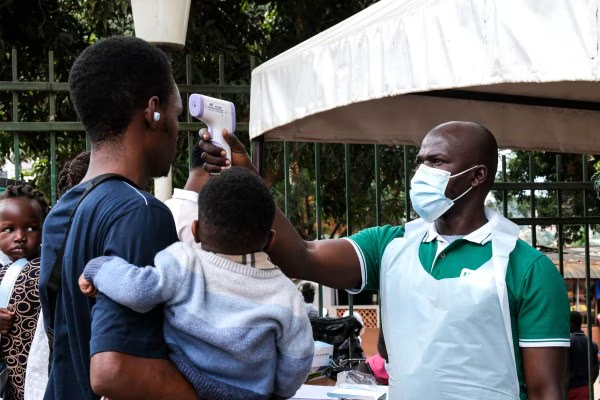
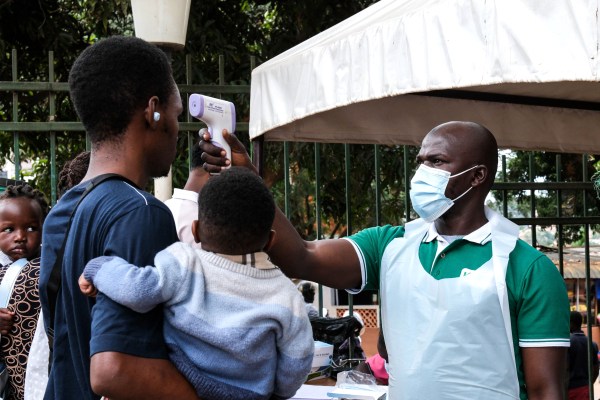 A health official uses a thermometer to screen people in front of Kibuli Muslim Hospital in Kampala, Uganda, on May 16, 2026. (AP)
The Q&A also pointed out that unlike Zaire, antiviral treatments for other strains are lacking, thus limiting treatment to supportive care, including rehydration, balancing electrolytes, and stabilising oxygen and blood pressure.
It also noted that non-pharmaceutical interventions — such as community engagement, active case finding and contact tracing, management and treatment of suspected and confirmed cases, and safe burials — were integral to any Ebola outbreak response. However, deploying such interventions can be challenging when case numbers are high, particularly in large urban centres and conflict zones.
Symptoms and diagnosis
The WHO fact sheet says that the period from infection to onset of symptoms (also called incubation period) varies from two to 21 days. Symptoms can be sudden and include fever, fatigue, malaise, muscle pain, headache, and sore throat, followed by vomiting, diarrhoea, abdominal pain rash, and symptoms of impaired kidney and liver functions.
Although bleeding is perceived as a common symptom, this is less frequent and can occur later in the disease. The disease is known to affect the central nervous system and cause confusion, irritability, and aggression.
Story continues below this ad
Diagnosis is often difficult, since early symptoms of Ebola are similar to those of other infectious diseases such as malaria, typhoid, meningitis, and other viral fevers.
[ad_2]
Source link